About This Course
I wrote this six-week curriculum for Allegheny College's Computer and Information Science department while working on the AquaGator research project. It is designed with two parallel paths: Path 1 builds real underwater ROVs, and Path 2 swaps in alternative activities (motors, sensors, and demonstrations with pre-built college robots) for classrooms without the funding for full builds. Every classroom deserves a version of this course, not just the funded ones.
The Six Week Arc
- Intro to Robotics and Intro to Arduino: what a robot is, and a first circuit with an LED, resistors, and hookup wire.
- Coding with Arduino: from the classic Blink up to juggling three LEDs and mixing colors on an RGB LED.
- ROV Design and Frame Building: design principles, then cutting and assembling the PVC frame.
- ROV Motor Control: wiring motors to toggle switches through the tether so the robot can be driven from the surface.
- Attaching and waterproofing the motors: soldering wire pairs, heat shrink, hot glue, and sealing putty.
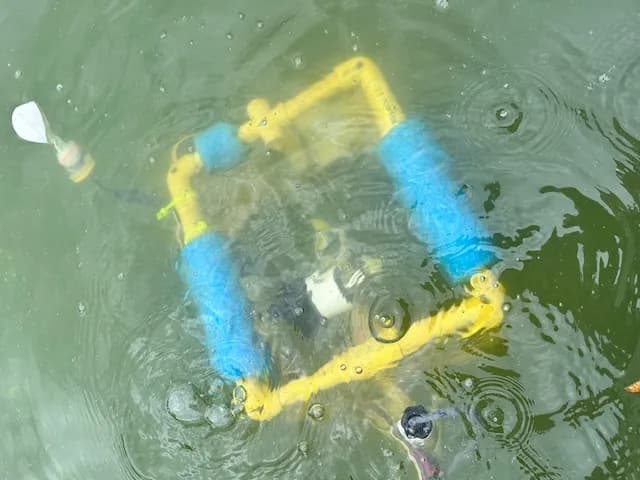
- Test day: take the robots to a pool or lake and find out what they can really do.
Test Day Is the Best Day
The robots need near neutral buoyancy to operate, so students experiment with pool noodles and weights until their ROV neither floats nor sinks. Then the games begin, and every game is secretly a measurement:
- Forward speed race: whose ROV is fastest in a straight line?
- Upward speed race: all ROVs start at the bottom, first to the surface wins.
- Straightness check: are both motors really spinning at the same speed?
- Depth test: mark the tether where it last touched water, then measure it.
- Turning: can it turn every direction? How long does a full 360 take?
The closing lesson matters most: engineers test, adjust, and test again. A robot that pulls to the left on test day is not a failure, it is the start of the next iteration.