Introduction
In an era where artificial intelligence increasingly permeates creative domains, questions arise about the uniqueness of human creativity. My senior thesis, Am.I.: A Robotic Replacement Unrealized, delves into this discourse by presenting a robotic artwork that challenges the notion of AI as a mere imitator of human creativity.
Project Overview
Am.I. is an interactive robotic installation featuring a 3D-printed skull equipped with moving eyes and jaw, programmed to engage in Socratic dialogues using large language models. The project aims to demonstrate that AI can extend human creativity rather than replace it, offering new perspectives on the human experience through technological integration.
Technical Implementation
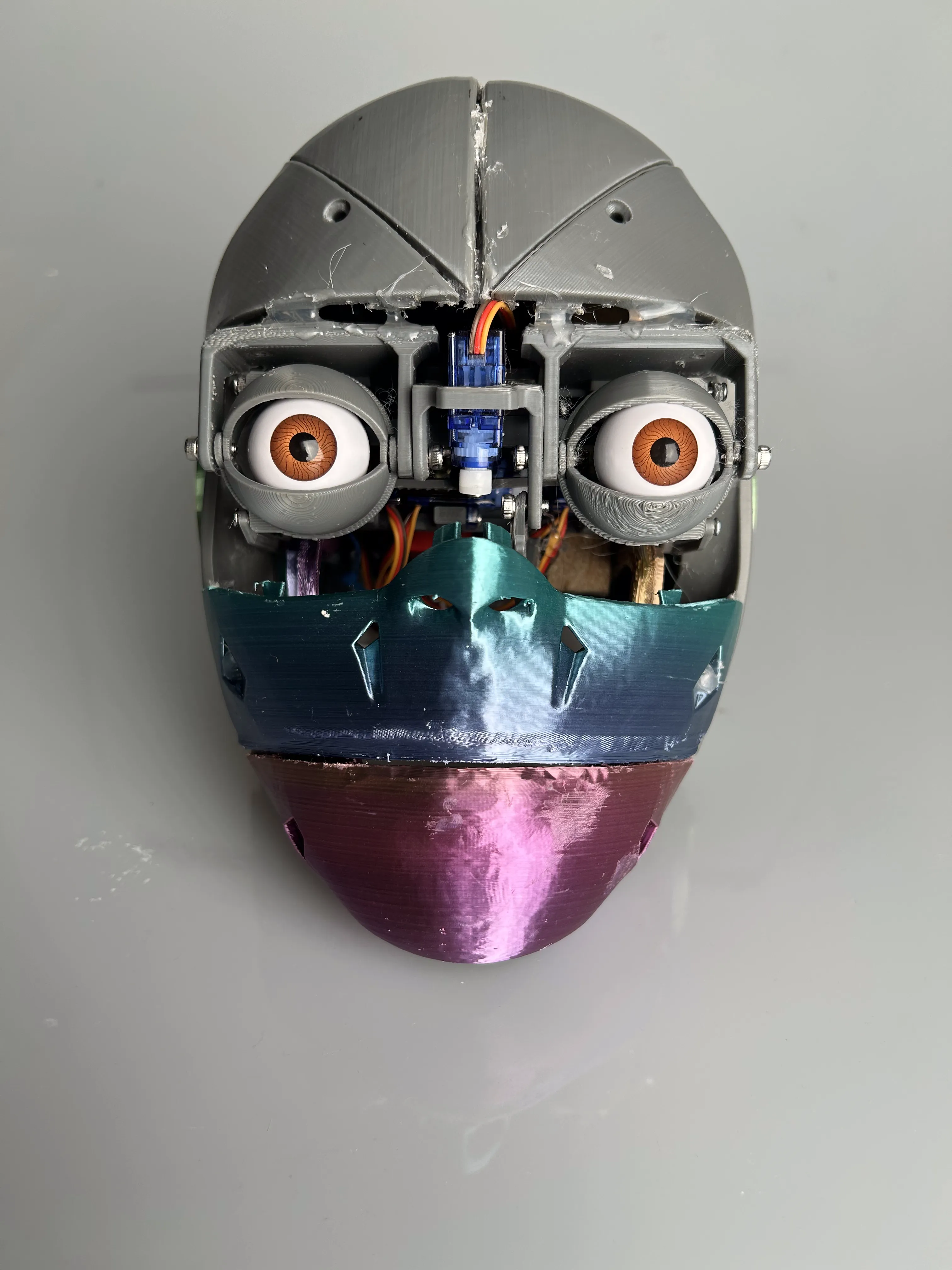
The robotic head was constructed using 3D printing techniques, with servos controlling facial movements. The system integrates Python programming, Arduino microcontrollers, and AI models to facilitate real-time conversations. The design emphasizes both aesthetic appeal and functional interactivity, creating an immersive experience for viewers.
Experiments and Findings
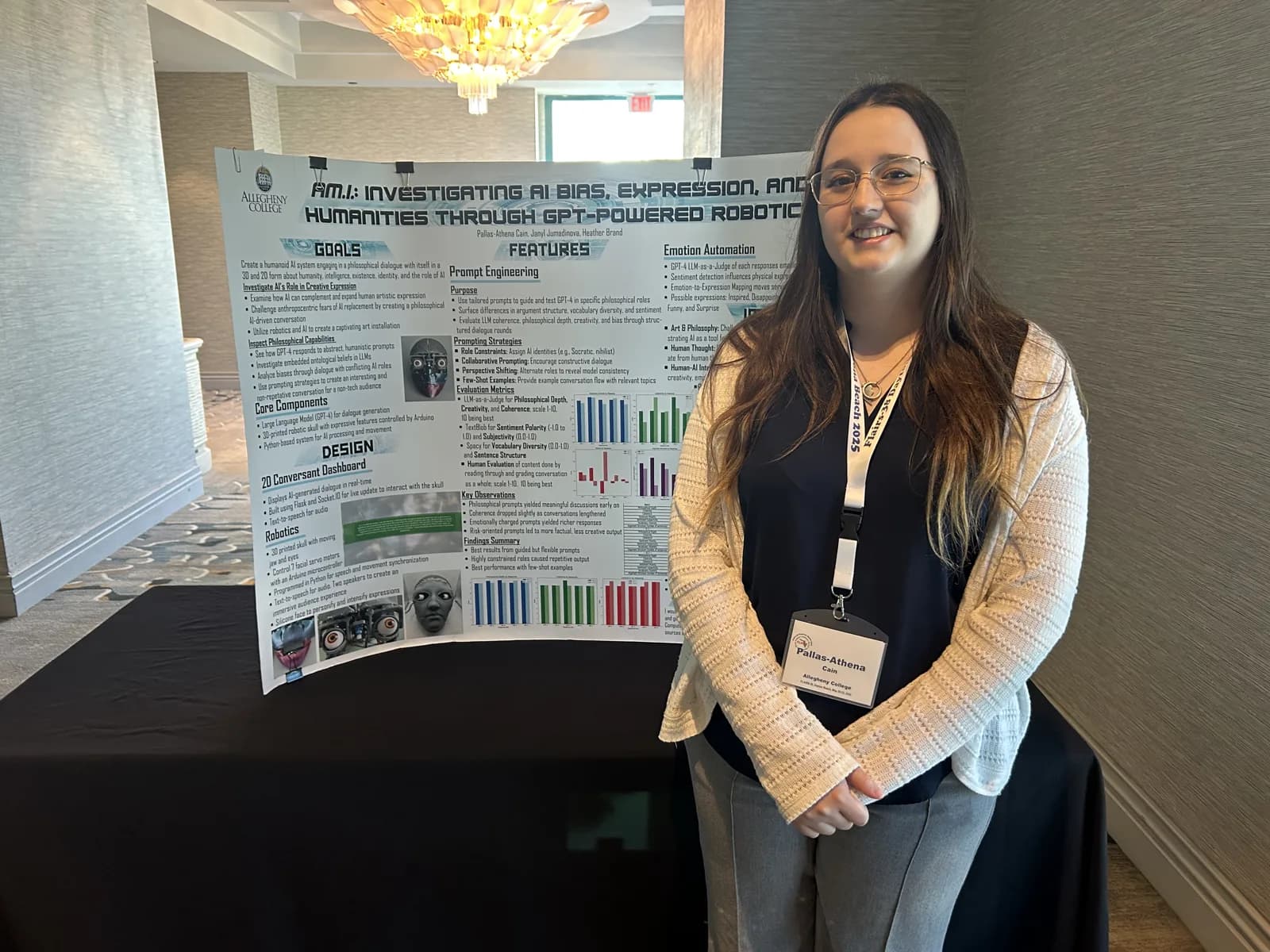
I conducted experiments to assess the robot's performance in expressing emotions and engaging in meaningful dialogues. The findings indicated that while the robot could simulate human-like interactions, it also highlighted the limitations and distinctiveness of human consciousness - reinforcing the idea that AI serves as a complement to human creativity.
Ethical Considerations
The thesis addresses ethical concerns related to AI, including potential misuse, job displacement, environmental impact, psychological effects, and inherent biases in AI models. It emphasizes the importance of responsible development and deployment of AI technologies to ensure they augment rather than undermine human values and experiences.
Building the Skull
The skull was 3D printed on an Ender-5 S1 from the EZ-Robot InMoov head files, with the eye mechanism coming from Will Cogley's EyeMech 1.0 design. The color choices were deliberate: gray PLA for the head to lean into the uncanny valley, and rainbow PLA for the ears and mouth to symbolize listening and speaking.
The pieces are held together with screws, nuts, and a lot of hot glue. The jaw gets its own little wooden stage: a glued corner of wood blocks holds the jaw servo, a half control horn connects the servo to the jaw support, and zip ties keep everything honest. The same wood platform doubles as a hidden shelf for the Arduino inside the skull.
Casting My Own Face
The face on the robot is mine. I made a negative mold of my own face in Smooth-On Body Double, with paper straws in my nose so I could breathe and a plaster bandage shell to hold the mold's shape. The whole sitting took about an hour, and it took multiple attempts because the first cast did not cover enough of my face.
The positive is Smooth-On Dragon Skin dyed a solid gray. To get a thin, mask-like skin instead of a solid blob, I rotated the mold continuously for fifteen minutes while the silicone set. Then came the X-Acto work: opening the eyes so the mechanical eyes show through, and cutting the mouth slightly larger than a human would open theirs, because a smaller mouth means more tension fighting the jaw servo. The face is glued on with Loctite plus a final blended layer of gray Dragon Skin, and it was held in place with wrapped wire for the 24 hours the glue took to cure.
Seven Expressions, Seven Servos
Seven servo motors live in the head: one large servo for the jaw and six micro servos for the eye mechanism, all wired to an Arduino Uno through a breadboard with resistor-color-coded signal wires. The Arduino sketch maps emotions to servo angle recipes: Inspired is relaxed eyelids with an upward-left gaze, Disappointed lowers the lids and the gaze, Confused darts back and forth wide-eyed, Concerned squints down to the right, Curious holds asymmetric eyelids with a straight gaze, Funny bobs quickly up and down, and Surprise is wide eyes straight ahead. Every servo installs a little differently, so the angles were tuned by honest trial and error.
The Software Stack
The brain is a Python 3.12 program that generates a continuous Socratic dialogue between two AIs using OpenAI's GPT-4. Each AI gets its own voice through pyttsx3 (in the gallery, Microsoft Hazel and Microsoft Zira), with numpy, wave, and sounddevice turning text into audio played through a USB speaker hidden near the body. pyserial sends each line's detected emotion and a talk command to the Arduino so the face moves with the words.
The conversation is also analyzed as it happens: textblob for sentiment, spacy for tokenization, nltk to filter stopwords, and scikit-learn to catch repeated conversation topics. Every file has pytest test cases behind it.
The Live Dashboard
A Flask dashboard runs on its own thread alongside the generation loop, pushing every new line to the browser in real time over flask-socketio. The main page shows the full conversation, the current emotions, and the line being spoken. Adding /amiart to the URL opens the stripped-down display that was used for the gallery presentation itself. flask-cors is switched on too, which leaves the door open for future internet of things experiments.
The Body and the Desk
The body is a child-size mannequin found at a local antique store, seated at a small elementary school desk from the same kind of hunt. The neck is PVC pipe painted gray, screwed into the wood base of the jaw motor, and a metal pole through the back keeps the whole figure sitting upright at its desk.
Conclusion
Am.I. stands as a testament to the potential of AI to enrich human creativity. By fusing art and technology, the work invites audiences to reconsider the boundaries between human and machine, advocating for a future where AI acts as a collaborative partner in the creative process.