From my Photography I portfolio at Allegheny College.
Final Essay
One of the most influential photographers in large format color film photography and capturing average North American life is Stephen Shore (International Center of Photography 2018). Shore's photography practice started in the early 1960s (The Art Story 2014). He used his landscape photography to document humanity and everyday American life in his most well-known series "American Surfaces" (Selvin 2020). Shore used his photography to capture the experiences of the small-town American life not seen on the big screen. He is well known for taking ordinary items and surroundings and turning them into objects of art (International Center of Photography 2018). On his road trip across America, he went to small towns throughout the United States and brought to light the small details missed by many (The Art Story 2014).
Along with the goal of capturing the unseen everyday life, Shore aspired to solve a dilemma with each set of photos (The Museum of Modern Art 2014.). For instance, Shore searched to achieve maximum clarity with his images (The Museum of Modern Art 2014). Initially, he used a smaller film camera but as his ambitions for clarity rose, so did the size of his camera (The Independent Photographer 2018). His style joins together bright colors with interesting contrasts (The Art Story 2014). The images that inspired me most are from his "American Surfaces" and "Uncommon Places" collections which feature a prominent 1970s color palette. I used this as my jumping-off point for this project. I wanted to emulate that goal for clarity and color while capturing the everyday world around me.
As for workflow, I was also interested in emulating his style because I knew it would be a challenge for me that I could learn from. First of all, Shore practiced taking as few shots as possible (The Museum of Modern Art 2014). This was the most challenging aspect for me, but I realized this was because film cameras use a lot of resources which I tend to take for granted when using a digital camera. Additionally, he takes a lot of street and town shots with few or no people in the background, and these took me a lot of patience. Thirdly, I noted that Shore uses a lot of unusual angles in his photos sometimes with corners missing or cut off. This was also challenging as I often try to include everything in my photos. Finally, the exposure of his images is higher than I would typically use. I identified these traits before starting my shooting because I wanted to learn from seeing through another artist's eye and find out where it would lead me.
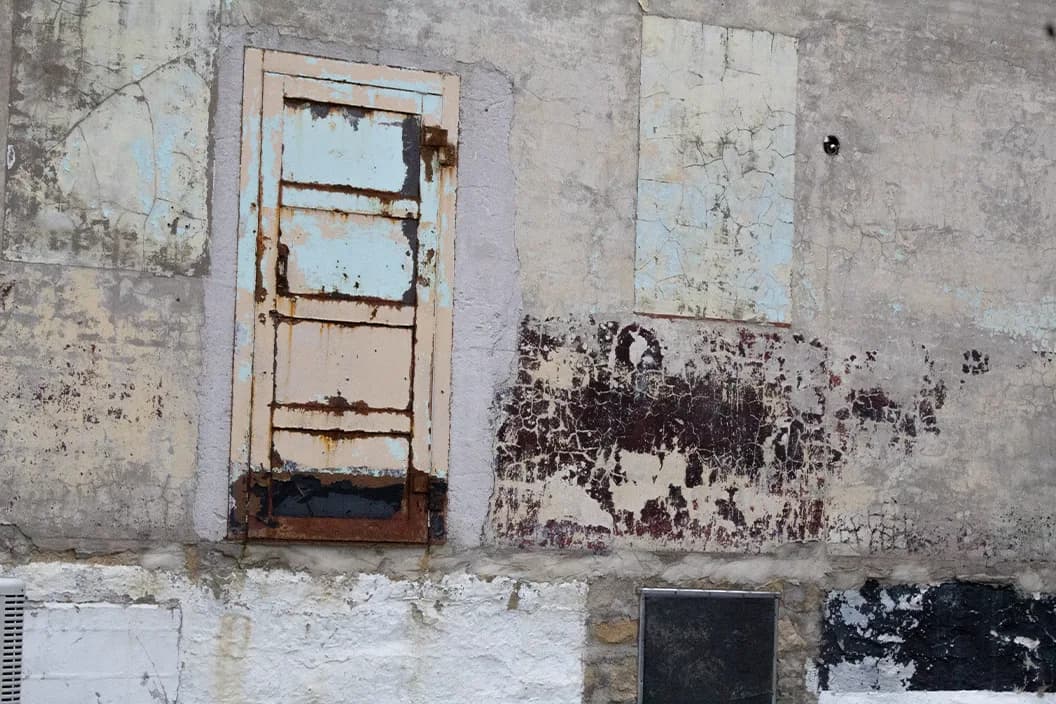
My first image of the door in an alley is a response to the "American Surfaces" collection, in particular, the rock wall in Queens, New York, 1972. Shore captures the wall and rock textures as well as contrasts the white rocks to the ground. The direction of the wall leading into the distance makes a very sharp line across the image. We do not see any people in the image but the rocks have clearly been painted. Shore's images often capture a world marked by humans with no one to be found such as photos of uneaten food or uncompleted puzzles. This theme makes me consider our impact on nature and society and how what we leave behind will be here after we are gone.
In my response, I was looking particularly at the flaky textures of the wall and the sharp lines of the door running along the wall parallel to the blocked-off window. The tints of light blue indicate to me that this wall was painted long ago and the pastels resemble that of the 1970s aesthetic, now almost completely worn away in the modern day. The tone of this image is very different from Shore's because it shows a lot more wear on the wall, almost like it progressed 50 years forward. The nostalgia from Shore's image becomes a sense of longing when put next to my even more cracked and decaying wall.
My second image is responding to Shore's "Uncommon Places" in particular the Sha-Mar Beauty Salon, Chestnut Street, Harrisburg, Pennsylvania, July 4, 1973. There is great detail in the architecture and the lines. He also captured the striking contrast between the greens and the blues. The exposure is high making the colors pop. The small town shop is reminiscent of the ones still seen today. There is a homey feeling to the image but an emptiness because of the lack of people.
For my response, I found a building that presented the same style of lines in the architecture as well as utilized contrasting colors, red and yellow-green. I was also comparing the brick building next to the colorful one in both images. I overexposed and edited my image to mimic the bright qualities of Shore's image. In contrast to Shore's photo, which was taken from a straight-on angle, I took mine from an angle of the backside of the building. I was inspired by the way that Shore took images of close-up pieces at an angle and applied that to the architecture shot. For this image, I wanted to bring to light the uniqueness of this building and make people give it a second thought much like Shore accomplishes through his imagery.
For the next image in the series, I staged a portrait photo. Shore would routinely include a portrait photo or two within a series of photos mainly focusing on landscapes (The Independent Photographer 2018). In that way, he was not only showing a diary of the places he saw on his journey but also the people he met. In his photo Michael and Sandy Marsh, Amarillo, Texas, September 27, 1974, from "Uncommon Places" he shot a picture of what the audience can assume is a couple cuddling on a floral couch. The figure on the bottom is staring directly at the camera while the figure on top is hiding their face. This photo is one of the most uneasy in this collection. The direct eye contact with the camera in this context makes the photo uncomfortable to look at. Alternatively, the patterns of the couch and the carpet are very eye-grabbing. The pattern of the carpet and the outline of the couch line up perfectly showing just how technical Shore's framing is upon closer examination (The Art Story 2014).
To counteract the uneasiness of the image, my response plays more into Shore's humorous side. In his South of Klamath Falls, U.S. 97, Oregon, July 21, 1973, from his "Uncommon Places" collection, we can understand how Shore finds humor in the way that man has changed the natural world. Building a billboard in the middle of a mountainscape of a mountainscape is extremely ironic (International Center of Photography 2018). I combined the concepts of these two images to create my portrait of the man lying on the couch with his dog. The dog itself is the one staring into the camera similar to the man in Shore's image. Now, the man is not making eye contact with the camera. I was thinking about how mankind changed the look of the dog to create the bull terrier by cultivating certain traits to give that breed the distinct look it has today. Without that human intervention, the bull terrier and many other breeds would not exist. The dog is not only looking into the camera but also wearing a sweater and holding a stuffed animal. All of these traits culminate in personifying the dog. The image also remains consistent with the bright contrasts and unique patterns as well as average household items.
The next photo in my series is responding to Shore's image of the alley in Henderson, North Carolina, in June 1972 from his American Surfaces collection. He uses a telephone pole and the corresponding wires to split the image into sections. Present are a lot of lines going in different directions such as the railroad markers, the telephone wires, the buildings, and the sidewalks which all give the viewer a greater sense of the distance traveled and the depth of field. The contrasts of natural light in the image are stunning as well with the dark shadows in the foreground leading into the bright sunlit background. I connected to this photo most of all because of how much it reminded me of my hometown. This image feels like I could see it on any average day. Shore's work makes a visual diary of the small-town American experience that communicates his life and is relatable to many (The Art Story 2014).
In my response, I saw an opportunity to play with lines as a way to show distance as well as separate different parts of the image. I took a closer look at the textures of the wood in the telephone pole as well as used it to separate the sidewalk from the street. The lines in the background from the wires and building lead into a curve as well which makes it feel like it is going toward the centerpoint. Initially, I wanted the sky to be blue just like Shore's image, but decided to lean into the modern reality of grey cloudy skies. I did not want to idealize the American small town and instead show the reality, which in this area tends to be a lot more grey. In the past, it was common to idealize America through photography, however, Shore did not shy away from showing pictures without romanticism (Selvin 2020). I appreciate this about his work and wanted to replicate it in mine.
Finally, my last image was a response to cars at Natural Bridge, New York, July 31, 1974, from Shore's "Uncommon Places" collection. In this photo, there is a striking green car in a lineup with another car. The grass and the car are similar in bright green color. The natural lighting on the hood of the car is very reflective. The tone of the image is nostalgic because of its everyday life appeal. The cars are very retro now because of the amount of time that has gone by since the shooting of this photo.
For my response, I wanted to hone in on the rural American aspect of Shore's images. In my opinion, the best symbol for that was a lineup of red tractors. The red of the tractors have a similar brightness in color as the car. The background of the road and houses is also representative of small-town America seen throughout the background of Shore's images. The angle I took the photo is also akin to the way Shore took many of his images from unique perspectives and angles. These tractors are very similar to the ones used decades ago and show how some aspects of technology change very little over time. Albeit, our cars look very different than the ones found in Shore's images there are still aspects of the past that look the same which is demonstrated through these tractors. Both of these images work to make the viewer think about technology and change over time or lack thereof.
Shore's images spark a feeling of nostalgia for the mundane life and small-town aesthetic. Through my photo-taking journey, I came to find that rural American life had not changed very much since the 1970s pictured in Shore's collections. I found that my hometown's architecture and layout look very reminiscent of Shore's images. As Shore quested to find the sentimental truth of the everyday in small-town America, I, in my quest to create a conversation with him discovered my roots in nostalgia for small-town America. I found his subjects were a part of my everyday life, and I grew a connection with him and his work I did not initially think was possible. It became not only a photographic journey in conversation but almost an emotional one with a deeper connection to home the more I reflect.
Bibliography
International Center of Photography. 2018. "Stephen Shore." International Center of Photography. January 31, 2018. https://www.icp.org/browse/archive/constituents/stephen-shore?all/all/all/all/0.
The Art Story. 2014. "Stephen Shore." The Art Story. The Art Story. 2014. https://www.theartstory.org/artist/shore-stephen/.
The Independent Photographer. 2018. "Stephen Shore: Uncommon Places | the Independent Photographer." The Independent Photographer. December 12, 2018. https://independent-photo.com/news/stephen-shore-uncommon-places/.
The Museum of Modern Art. 2014. "Stephen Shore | MoMA." The Museum of Modern Art. MoMA. 2014. https://www.moma.org/artists/5409.
Selvin, Claire. 2020. "Why Is Stephen Shore's 'American Surfaces' Important?" ARTnews.com. ARTnews.com. May 26, 2020. https://www.artnews.com/feature/stephen-shore-american-surfaces-1202688481/.
Shore, Stephen. 2023. "Stephen Shore." Stephenshore.net. 2023. http://stephenshore.net/photographs.php.